
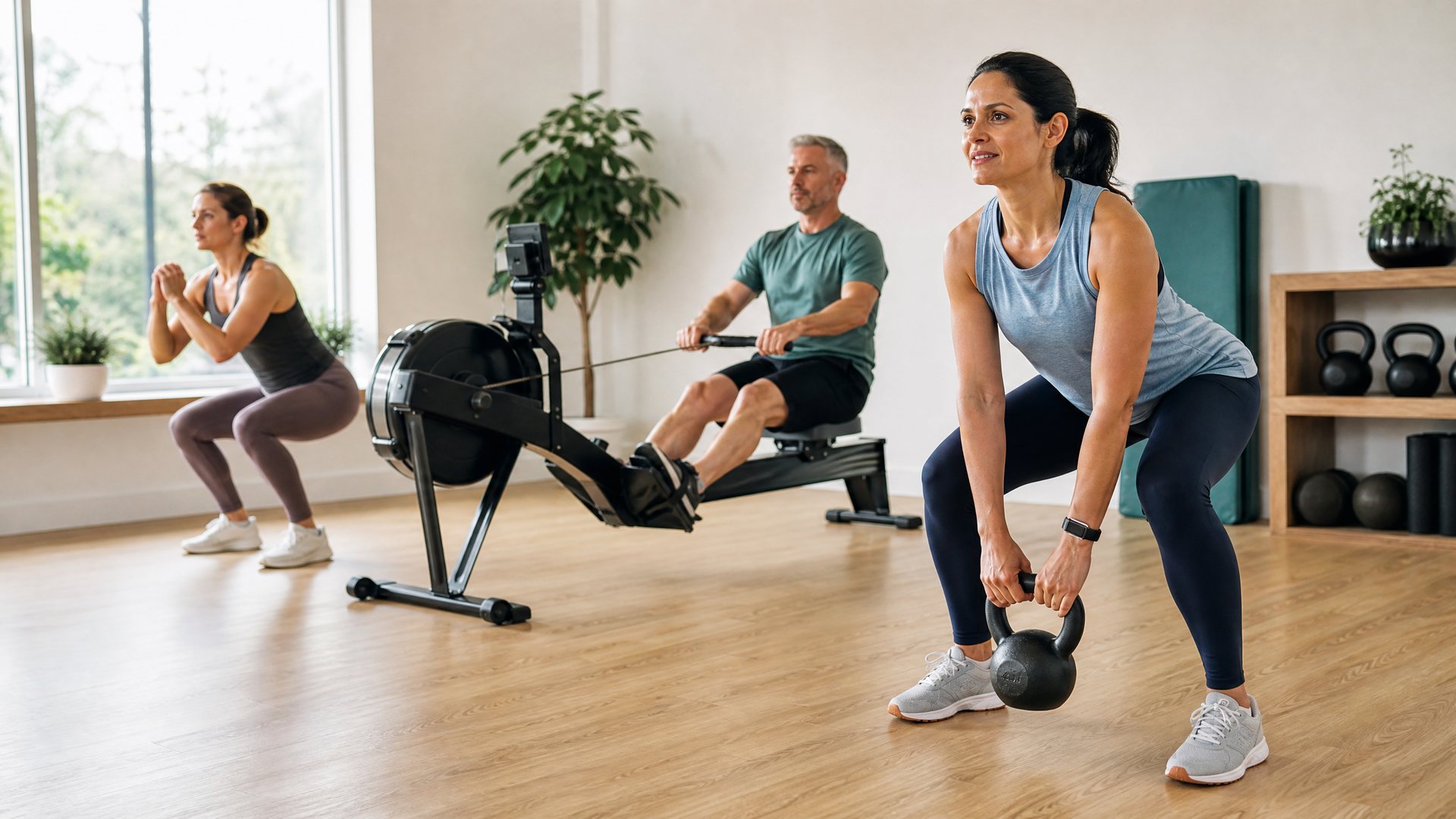
For most healthy adults, 3–5 planned exercise sessions per week is a practical way to reach the research-backed baseline: at least 150 minutes of moderate-to-vigorous aerobic activity and muscle-strengthening work at least twice weekly. Beginners can start with 2–3 structured sessions. Your best frequency changes with workout intensity, total weekly volume, current fitness and recovery—not a single magic number.
Key Takeaways
- Canadian guidance sets a weekly target of at least 150 minutes of moderate-to-vigorous aerobic activity—not a mandatory number of workout days.
- Strengthening all major muscle groups at least twice weekly is the public-health baseline for adults.
- For muscle growth, progressive training and manageable weekly volume matter more than forcing a specific number of training days.
- Beginners can build consistency with 2–3 structured sessions per week before adding more work.
- Research commonly studies 2–3 HIIT sessions per week, but no authoritative guideline sets a universal HIIT maximum.
- Recovery belongs in the program; persistent pain, unusual fatigue or falling performance signals a need to reduce or delay hard training.
In This Article
If you have ever stood in your kitchen at 6 a.m. debating whether today is a rest day or an excuse, you are not alone. Workout frequency is one of the most common fitness questions—and the research gives a more flexible answer than most rigid online programs suggest.
The number of days on your calendar matters less than what you do across the full week. Your goals, training intensity, weekly workload, experience and recovery determine how many structured sessions you can use productively.
This guide breaks down the public-health targets, the evidence behind strength and HIIT frequency, and a realistic weekly schedule you can sustain.
How Often Should You Work Out? The Short Answer
For most healthy adults, 3–5 planned exercise sessions per week is a practical structure. It gives you enough room to combine aerobic work, strength training and recovery while working toward the Canadian and World Health Organization activity targets.1, 2
The research-backed baseline is:
- At least 150 minutes of moderate-to-vigorous aerobic activity per week under Canada's current adult movement guideline
- 150–300 minutes of moderate-intensity activity, 75–150 minutes of vigorous activity, or an equivalent combination under WHO guidance
- Muscle-strengthening activity for all major muscle groups on at least 2 days per week
- Regular light movement and less sedentary time throughout the week
These are weekly public-health targets, not a rule that you must train on exactly three, four or five days. Short bouts count, and some activity is better than none. A three-day full-body program, five shorter sessions and many other schedules can all work.
What the Research Actually Says
The Canadian Society for Exercise Physiology and WHO agree on the central message: accumulate meaningful aerobic activity, strengthen the major muscle groups and reduce prolonged sedentary time.1, 2 Neither organization identifies one universally optimal number of gym visits.
Cardio Frequency Guidelines
You do not have to divide cardio across exactly 3–5 days for the minutes to count. A distributed schedule is often easier to manage because each session can be shorter and less fatiguing, but the official target is based on weekly volume.
For many people, three to five cardio exposures—including brisk walking, cycling, spin, intervals or mixed classes—creates a workable rhythm. The best schedule is the one that lets you reach an appropriate weekly volume without turning every session into an all-out effort.
Strength Training Frequency Guidelines
For general health, train all major muscle groups at least twice weekly.1, 2 That can mean:
- Two full-body sessions
- Three shorter full-body sessions
- An upper/lower split across four days
- Another split that distributes the same weekly work effectively
For strength and muscle growth, frequency is primarily a tool for organizing productive weekly training. Research supports progressive resistance training, multiple sets and a manageable weekly volume; when weekly volume is matched, simply adding more training days does not consistently produce more muscle growth.3, 4
Key point: More days do not automatically create better results. The useful question is whether your weekly workload is challenging enough to drive progress and recoverable enough to repeat.
How Often Should You Work Out Based on Your Goals?
Your goal changes the mix of work—not the underlying need for consistency and recovery. The ranges below are practical starting schedules, not universal prescriptions.
| Goal | Practical weekly starting point | Main focus |
|---|---|---|
| General health and longevity | 3–5 planned sessions | Aerobic activity, full-body strength and regular daily movement |
| Weight loss or fat loss | 3–5 planned sessions | Strength training, aerobic activity and sustainable nutrition |
| Muscle and strength | 2–4 resistance sessions | Progressive loading and manageable weekly volume |
| Athletic performance | Program-specific | Sport practice, strength, conditioning and recovery |
| Beginner or returning to exercise | 2–3 structured sessions | Full-body foundational movement and gradual progression |
| Cardiovascular fitness using HIIT | 1–2 HIIT sessions to start | Quality intervals plus easier aerobic activity |
Weight Loss
For fat loss, consistency and total weekly activity matter more than chasing the hardest possible workout. A sustainable plan usually combines resistance training, moderate aerobic work and everyday movement such as walking.
Three to five planned sessions gives many people enough structure to build fitness and increase energy expenditure without relying on daily high-intensity training. Nutrition still controls the energy deficit required for fat loss, while strength training helps preserve or build lean tissue.
Muscle Building
If your priority is strength or muscle, two weekly resistance exposures per major muscle group is a practical default—not a biological rule. Weekly volume, progressive overload, exercise selection, protein intake and sleep drive the program.
More training days can help you distribute sets and maintain quality. They do not rescue a program with poor progression or inconsistent effort. If you want a plan built around your current strength, schedule and recovery, Anchor's personal training provides one-on-one programming and coaching.
General Health and Longevity
For general health, organize the Canadian weekly target in the simplest pattern you can repeat. Three to five sessions can cover cardio and strength, while walking and other light movement fill the space between structured workouts.
You do not need to train like an athlete to gain meaningful health benefits. You need enough weekly movement, an appropriate challenge and a schedule that survives busy weeks.
How Many Times a Week Should Beginners Work Out?
For someone new to structured exercise, 2–3 sessions per week is a strong starting point. This is a conservative programming recommendation, not a mandatory guideline.
Starting with fewer, repeatable sessions works because:
- Your body gets time to learn unfamiliar movement patterns
- You can assess soreness and recovery before adding volume
- Each workout is easier to fit into a real schedule
- Consistency becomes the first progression target
- The risk of turning one ambitious week into a long layoff drops
A realistic beginner week can include one full-body strength session, one beginner-friendly interval or AnchorHIIT class, and one moderate cardio session or longer walk. After four to six consistent weeks, add work only when your technique, energy and recovery remain solid.
Why Rest Days Matter
Training creates the stimulus. Recovery allows your body to adapt to it. A useful weekly plan therefore controls how hard sessions are arranged rather than treating every open day as an opportunity to push harder.
Watch for patterns—not one isolated bad workout:
| Warning sign | Practical response |
|---|---|
| Soreness that limits normal movement or the next session | Reduce load, range, volume or intensity until it settles |
| Declining performance across repeated sessions | Review total workload, sleep, nutrition and recovery time |
| Persistent fatigue or worsening sleep | Replace the next hard session with rest or easy movement |
| Loss of motivation combined with physical fatigue | Reduce training demand rather than forcing intensity |
| Recurring pain or repeated minor injuries | Stop aggravating work and seek qualified assessment |
An active-recovery day can include walking, easy cycling, mobility work or gentle stretching. It should leave you feeling better, not become another disguised high-intensity session.
HIIT Frequency: How Often Is Too Often?
HIIT is time-efficient and can improve cardiorespiratory fitness, but there is no authoritative, universal cap of 2–4 sessions per week. HIIT studies use widely different formats, populations and weekly frequencies, so one hard limit cannot cover cycling intervals, running sprints, rowing, kettlebell circuits and high-impact classes.5

For beginners, one or two nonconsecutive HIIT sessions per week is a conservative starting schedule. Research commonly uses two or three weekly sessions, but that does not make three the ideal number for every person.
Increase HIIT only when your technique, performance, sleep and joints are handling the current workload. Reduce or delay the next hard session when pain, unusual fatigue, worsening soreness, declining performance, dizziness or an abnormal exercise response persists.
At an indoor studio in Keswick, a balanced week can pair two quality HIIT sessions with lower-impact cardio such as Anchor Ride, walking or easy cycling. That structure gives you intensity without making intensity the entire plan.
HIIT takeaway: Treat one or two weekly sessions as a starting example, then adjust from real recovery and performance—not an arbitrary universal maximum.
Building a Weekly Workout Schedule That Works
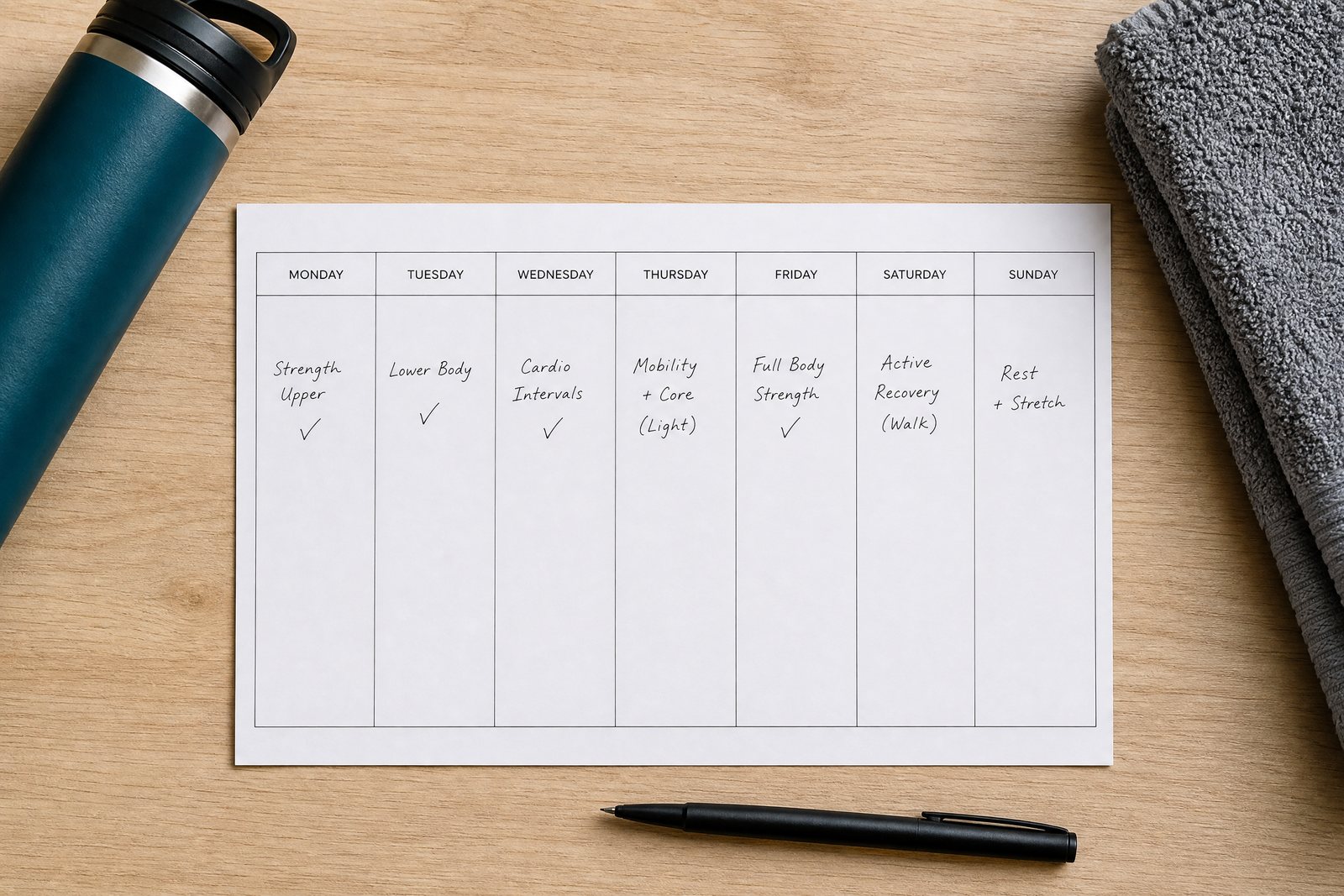
Here is a balanced example for general health and body-composition goals:
| Day | Focus |
|---|---|
| Monday | Full-body strength training |
| Tuesday | HIIT or interval cardio |
| Wednesday | Active recovery: walking, mobility or stretching |
| Thursday | Full-body strength or an upper/lower split session |
| Friday | Spin or moderate cardio |
| Saturday | Optional light activity, class or recreational movement |
| Sunday | Full rest |
This schedule includes two strength sessions, one higher-intensity cardio session, one moderate cardio session and built-in recovery. A more experienced person can add a second interval day. A beginner can remove the optional session and keep the same weekly structure.

The Bottom Line
There is no single magic number of weekly workouts. For most healthy adults, 3–5 planned sessions is a practical way to reach the evidence-based aerobic and strength targets. Beginners can start with 2–3 sessions. Strength training should cover all major muscle groups at least twice weekly, and HIIT should start at a frequency your technique and recovery can support.
The winning schedule is not the one that looks hardest on paper. It is the one that produces enough quality work to drive progress and remains sustainable week after week.
Ready to stop guessing and start training with a plan? Review Anchor's class schedule and build your week with AnchorHIIT, Anchor Ride and one-on-one personal training at our Keswick fitness studio.
This article provides general education, not individualized medical or training advice. If you are inactive, pregnant, recovering from injury or managing a chronic condition, get condition-appropriate guidance from a qualified clinician or exercise professional before materially increasing training. Chest pain, fainting or severe unexplained shortness of breath requires prompt medical assessment.
References
- Canadian 24-Hour Movement Guidelines for Adults aged 18–64 years — Canadian Society for Exercise Physiology, 2020.
- WHO Guidelines on Physical Activity and Sedentary Behaviour — World Health Organization, 2020.
- Resistance Training Prescription for Muscle Function, Hypertrophy, and Physical Performance in Healthy Adults — American College of Sports Medicine position stand, 2026.
- Resistance Training Prescription for Muscle Strength and Hypertrophy in Healthy Adults — British Journal of Sports Medicine, 2023.
- High-Intensity Interval Training and Cardiorespiratory Fitness in Adults — umbrella review, Scandinavian Journal of Medicine & Science in Sports, 2024.
Build Your Weekly Plan
Find the right class mix at Anchor
Choose from AnchorHIIT, Anchor Ride and personal training, with coaching that helps you train consistently and recover properly.