
What Is Diastasis Recti - And How Do You Know If You Have It?
If you've noticed a strange gap down the centre of your belly, a persistent "pooch" that won't go away no matter how much you exercise, or a feeling that your core just isn't working the way it used to - diastasis recti could be the reason. This condition is far more common than most people realize, yet it often goes undiagnosed for months or even years after pregnancy. Understanding what diastasis recti is, how to recognize the signs, and what to do next is one of the most important steps you can take for your postpartum health and recovery.
What Is Diastasis Recti?
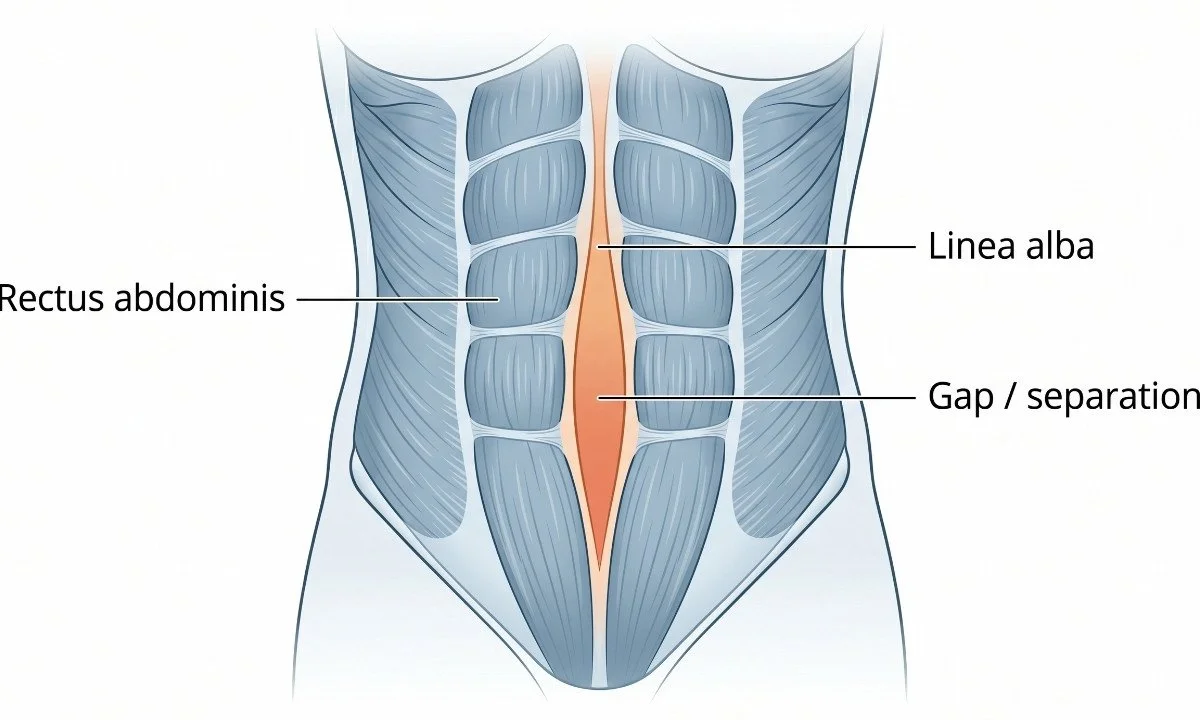
Diastasis recti (DR) is a separation of the two sides of the rectus abdominis - the paired muscles that run vertically down the front of your abdomen. These two columns of muscle are connected by a band of connective tissue called the linea alba. Under normal circumstances, the linea alba holds everything snugly together.
During pregnancy, the growing uterus pushes outward and upward, stretching the abdominal wall and placing enormous tension on the linea alba. Over time - and especially in the third trimester - this connective tissue can thin and widen, causing the two sides of the rectus abdominis to drift apart. That separation is diastasis recti.
It's not a muscle tear. The muscles themselves are intact; it's the connective tissue bridge between them that becomes overstretched and loses its integrity. This distinction matters because treatment is very different from a standard muscle strain.
Who Does It Affect?
Diastasis recti is primarily associated with pregnancy, but it can affect anyone:
Pregnant and postpartum women - the most commonly affected group, with studies suggesting up to 100% of women have some degree of DR by the third trimester
Women who have had multiple pregnancies, particularly those close together
People who carry excess abdominal weight or have experienced rapid weight changes
Men and children - though far less commonly, DR can occur in men who perform heavy lifting with poor technique, or in infants (usually resolving on its own)
Anyone with chronically elevated intra-abdominal pressure, such as those with persistent constipation, heavy chronic coughing, or frequent breath-holding during exercise
The important thing to know: having diastasis recti is not your fault, and it is not a sign that you exercised wrong or were somehow careless during pregnancy. It is a physiological response to the extraordinary demands pregnancy places on the body.
How Does Diastasis Recti Develop?
Understanding the mechanism helps you understand why certain activities can make it worse - and why the right kind of movement is so essential.
The linea alba is made of collagen fibres. Under normal tension, it is elastic and strong. But when intra-abdominal pressure rises - whether from a growing baby, repeated heavy lifting, or exercises that cause the abdomen to "dome" or "cone" - those fibres are placed under continuous load.
Key contributing factors include:
Hormones. Relaxin, a hormone produced during pregnancy, softens connective tissue throughout the body to allow the pelvis to expand. Unfortunately, it affects the linea alba as well.
Posture and load management. How you carry yourself and how you transfer load through your trunk significantly influences how much strain the linea alba bears.
Exercise choices. High-impact abdominal exercises - particularly crunches, sit-ups, double-leg raises, and heavy front-loaded squats - can increase intra-abdominal pressure in ways that aggravate an existing separation.
Multiple pregnancies. Each successive pregnancy can compound existing laxity in the linea alba.
It's also worth noting that the width of the gap alone does not determine severity. Research now emphasizes that the tension and depth of the linea alba matter just as much. A very wide separation with good tissue tension may cause fewer functional problems than a narrower gap with poor tension and low load transfer capacity.
Diastasis Recti Symptoms: What Does It Feel Like?
This is where many people get confused. Diastasis recti doesn't always cause pain. In fact, many women have significant separations and feel nothing unusual - until they start noticing functional problems or physical changes they can't explain.
Common signs and symptoms include:
A visible "ridge" or bulge running vertically down the centre of the abdomen, particularly noticeable when you sit up or strain
A "pooch" or dome in the belly that persists well after pregnancy, often mistaken for leftover baby weight
Lower back pain that doesn't resolve with typical back care
Pelvic floor dysfunction, including leaking urine when you sneeze, cough, or exercise
A feeling of weakness or instability in the core, like your midsection just won't "engage"
Pelvic girdle pain or hip discomfort
Bloating or digestive issues, particularly a feeling of pressure in the abdomen
It's easy to see why these symptoms are so frequently dismissed or attributed to other causes. Back pain, bladder leaking, and belly changes are often normalized as "just part of being a mom" - but they don't have to be.
The Connection Between Diastasis Recti and Pelvic Floor Dysfunction
The deep core and pelvic floor work as an integrated pressure management system. Think of your core as a canister: the diaphragm is the lid, the pelvic floor is the base, the deep abdominals (transversus abdominis) form the walls, and the multifidus muscles support the back.
When diastasis recti compromises the front wall of this canister, the whole system's ability to manage intra-abdominal pressure is disrupted. This is why many women with DR also experience pelvic floor symptoms - the two issues are deeply interconnected, not separate problems.
How to Check for Diastasis Recti at Home

You can perform a basic self-check for diastasis recti at home. This won't replace a professional assessment, but it gives you a starting point.
Step-by-step self-check:
Lie flat on your back with your knees bent and feet flat on the floor.
Place your fingertips horizontally across the midline of your abdomen, just above the navel.
Slowly lift only your head and shoulders off the floor - as if doing a very small crunch.
Feel for a gap or a soft, "squishy" area under your fingers where the two sides of the rectus abdominis have separated.
Note how many fingers fit into the gap, and whether the tissue feels firm or soft/lacking tension.
Repeat the check just below the navel and at the navel itself, as the gap width can vary across different points.
General reference points:
Gap Width
What It May Indicate
Less than 2 finger-widths
Typically within normal range
2–3 finger-widths
Possible diastasis recti - assessment recommended
3+ finger-widths
Likely diastasis recti - professional assessment advised
Any width with "squishy" depth
Tissue tension is low - professional assessment advised regardless of width
Important caveat: A finger-width measurement is not a precise diagnostic tool. The tissue depth and tension - how firm or how "hollow" it feels - matter just as much as the gap size. The only way to get an accurate assessment is through a hands-on evaluation by a qualified pelvic floor physiotherapist or trained chiropractor.
What Diastasis Recti Is NOT: Common Misconceptions
There is a lot of misinformation circulating online about diastasis recti. Here are a few important clarifications:
Myth: "You just need to do more core work." Doing the wrong kind of core work - especially exercises that cause doming or that increase intra-abdominal pressure - can actively make DR worse. Planks, crunches, and heavy lifting without proper technique are often contraindicated in the early stages of recovery.
Myth: "It only happens after childbirth." While pregnancy is the most common cause, DR can also develop in men, older adults, and people who have never been pregnant.
Myth: "If it doesn't hurt, it's not a problem." A painless separation can still significantly compromise core function, posture, and load transfer - creating downstream problems in the back, hips, and pelvic floor.
Myth: "Surgery is the only solution." The vast majority of diastasis recti cases respond extremely well to targeted rehabilitation - specifically, properly sequenced physiotherapy and exercise programming that re-trains the deep core before loading the outer abdominals.
How Is Diastasis Recti Diagnosed and Treated?
Professional Assessment
A proper diagnosis involves a hands-on assessment from a pelvic floor physiotherapist or a clinician trained in postpartum rehab (such as a chiropractor with a postnatal specialization). They will measure the width and depth of the gap, assess linea alba tension, evaluate core and pelvic floor function, and screen for any related symptoms.
Ultrasound imaging is sometimes used to provide a more detailed view of the linea alba, particularly in cases that are unclear on physical examination.
Rehabilitation - The First-Line Approach
Rehabilitation is the gold standard first-line treatment for diastasis recti. A well-designed program typically progresses through the following stages:
Reconnecting with the deep core - learning to activate the transversus abdominis and pelvic floor without increasing intra-abdominal pressure
Managing pressure and load - modifying movements and daily tasks (like getting out of bed, lifting, and carrying) to reduce unnecessary strain on the linea alba
Progressive loading - gradually reintroducing resistance and functional movement as the core system becomes more coordinated
Return to exercise - safely reintroducing higher-demand activities like running, HIIT, and strength training with appropriate technique and load management
Exercise programming for diastasis recti recovery is not one-size-fits-all. The right program depends on the severity of the separation, the state of the pelvic floor, and your personal goals. This is why working with a qualified professional - rather than following a generic "DR workout" from the internet - is strongly recommended.
When Is Surgery Considered?
Surgery (abdominoplasty or tummy tuck) may be discussed when conservative rehabilitation has been completed thoroughly but functional impairment persists, or when there is an associated hernia. Surgery does not replace rehabilitation - in fact, pre- and post-surgical rehab is essential for optimal outcomes. However, for the overwhelming majority of people, targeted rehabilitation achieves excellent functional and cosmetic results without surgical intervention.
What Exercises Should You Avoid With Diastasis Recti?
Until you've had a professional assessment and begun a guided program, it's generally wise to be cautious with:
Traditional crunches and sit-ups
Double-leg raises
Full planks (modify to incline planks or forearm planks with careful monitoring)
Heavy lifting without breath management
High-impact activities that cause visible doming or coning in the belly
Twisting movements under load
This doesn't mean you need to be sedentary - far from it. Movement and gentle exercise are beneficial and encouraged. The key is choosing the right movements and learning how to manage intra-abdominal pressure effectively as you gradually rebuild strength.

Diastasis Recti FAQs
Q: How long does it take to recover from diastasis recti?
Recovery timelines vary widely depending on the severity of the separation, how long it has been present, your overall health, and how consistently you engage with your rehabilitation program. Some women see significant improvement within 8–12 weeks of guided rehab; others may take 6–12 months to achieve their goals. What matters most is progression - seeing improvements in core function, symptom reduction, and your ability to return to the activities you love.
Q: Can diastasis recti heal on its own without treatment?
Some mild separations do improve spontaneously in the weeks immediately following birth, as hormones normalize and the uterus involutes. However, research consistently shows that moderate to severe cases do not reliably close without targeted rehabilitation. More importantly, even if the gap narrows over time, that doesn't mean the linea alba has regained functional tension - which is ultimately what determines how well your core functions.
Q: Is it safe to exercise with diastasis recti?
Yes - with the right guidance. Exercise is an essential part of recovery. The goal is to learn which movements support healing versus which ones place the linea alba under excessive strain. A pelvic floor physiotherapist or postnatal rehab specialist can help you build a program that keeps you active and moving forward safely.
Q: Does diastasis recti cause a permanent belly pooch?
Not necessarily. The "mommy pooch" associated with DR is largely caused by the forward displacement of abdominal contents through the weakened midline - not by fat alone. As the linea alba regains tension and the deep core reconnects, many women see a visible and meaningful improvement in the appearance of their abdomen. This is one of the most motivating outcomes of a well-executed rehab program.
Q: When should I see a professional about diastasis recti?
You should seek a professional assessment if you notice any of the following: a visible ridge or doming down the midline, persistent low back pain postpartum, any degree of pelvic floor leaking, a feeling of core weakness that isn't improving, or if you've been cleared for exercise but feel something is "off" when you work out. There is no such thing as too early to get checked. In fact, an early assessment allows you to protect and support your recovery right from the start.
The Bottom Line on Diastasis Recti
Diastasis recti is common, underdiagnosed, and very treatable. If you've noticed a gap in your abdominal muscles, a persistent belly bulge, unexplained back pain, or pelvic floor issues following pregnancy - or even without a pregnancy history - this condition deserves your attention.
The most important message: you don't have to just live with it. The body has a remarkable capacity to heal and rebuild when it receives the right support. A professional assessment gives you a clear picture of what's happening, and a targeted rehabilitation program gives you the tools to genuinely recover - not just manage symptoms, but rebuild a core that functions fully and confidently.
Your postpartum body carried and delivered something extraordinary. It deserves expert care to match.
At Anchor Health and Fitness Centre in Keswick, ON, our team specializes in postpartum rehabilitation, pelvic floor physiotherapy, and guided postnatal fitness programs designed specifically for moms who are ready to feel strong again. Whether you're six weeks postpartum or six years, it's never too late to start.
Book your assessment at Anchor today and take the first real step toward a core that works for you - not against you. Call us at (905) 535-4449 or visit anchorhere.ca to get started.
