
What Is Sciatica? Symptoms, Causes, and When to See a Physio
If a sharp, burning pain has ever shot from your lower back down through your buttock and leg, you already know how disruptive sciatica can feel. It's one of the most common reasons people search for relief, yet it's also one of the most misunderstood conditions in musculoskeletal health. Understanding what sciatica is - and recognizing when it's time to bring in a professional - can be the difference between weeks of guesswork and a clear path back to moving normally.
Many people try to push through the discomfort, assuming it will fade like an ordinary muscle ache, only to find that it lingers for weeks or worsens with everyday activities like sitting at a desk or bending to pick something up. Others jump straight to worst-case assumptions about surgery before exploring far more common, far less invasive solutions.
In this guide, we'll break down what sciatica actually is, what causes it, how to tell it apart from ordinary back pain, and exactly when to see a physiotherapist for lasting relief.
What Is Sciatica, Really?
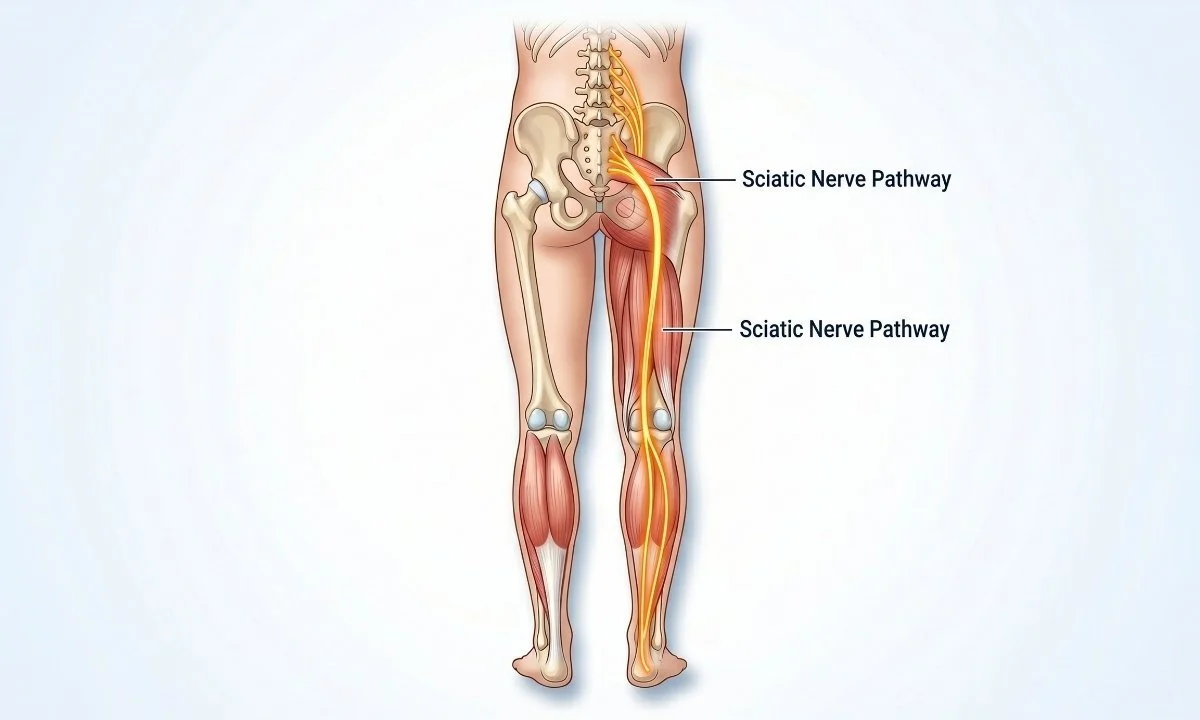
Despite how often the word gets used, sciatica isn't actually a diagnosis on its own. It's a symptom - a description of pain that travels along the path of the sciatic nerve, the longest and widest nerve in the human body.
When something irritates or compresses this nerve, the result is pain, tingling, or numbness that can run from the lower back through the buttock, down the back of the thigh, and sometimes all the way to the foot. The underlying cause can vary widely from person to person, which is part of why a proper assessment matters so much.
The Sciatic Nerve: Your Body's Longest Nerve
The sciatic nerve forms from several nerve roots in the lower spine (L4 through S3) and travels through the buttock, down the back of each leg, branching out near the knee. Because it's such a long structure, irritation anywhere along its path - from the spine to the hip to the hamstring - can produce symptoms that feel like sciatica even when the spine itself isn't the source.
What Does Sciatica Feel Like? Common Symptoms
Sciatica symptoms can range from a mild ache to pain so severe it limits walking, sitting, or sleeping. Most people notice one or more of the following:
Radiating pain that travels from the lower back or buttock down one leg, usually affecting only one side
A burning or electric-shock sensation that worsens with sitting, coughing, or sneezing
Numbness or tingling (pins and needles) along the back of the leg or in the foot
Muscle weakness in the leg or foot, sometimes making it hard to lift the front of the foot
Pain that feels worse after prolonged sitting and slightly better when walking or lying down
It's worth noting that the intensity of the pain doesn't always match the severity of the underlying issue. Some people with significant nerve compression have only mild symptoms, while others with a smaller issue feel debilitating pain.
What Causes Sciatica?
Sciatica happens when something compresses or irritates the nerve roots that form the sciatic nerve. Several conditions can be responsible, and identifying the right one is essential to choosing the right treatment.
Common Causes of Sciatic Nerve Pain
Herniated or bulging disc - Disc material presses on a nearby nerve root. Most common in adults 30–50, especially after lifting or twisting.
Spinal stenosis - Narrowing of the spinal canal puts pressure on nerves. Most common in adults over 50.
Piriformis syndrome - A tight or inflamed piriformis muscle compresses the nerve near the hip. Common among runners, cyclists, and desk workers.
Spondylolisthesis - A vertebra slips forward, narrowing the space nerves pass through. More common in adults with prior spinal stress or injury.
Pregnancy-related sciatica - Postural shifts and pelvic changes place pressure on the nerve, especially in the third trimester.
Prolonged sitting or poor posture - Sustained pressure and tight hip muscles irritate the nerve pathway. Common among office workers and drivers.
Lifestyle Factors That Increase Risk
Beyond the structural causes above, certain everyday habits can make sciatica more likely or slower to resolve. Carrying excess weight places additional load on the lower spine and discs, while a sedentary lifestyle weakens the core and hip muscles that normally support the lower back. Jobs involving heavy lifting, twisting, or long hours of driving also raise risk, as does smoking, which has been linked to faster disc degeneration. None of these factors guarantee sciatica will develop, but they're worth addressing as part of a long-term prevention strategy.
How Is Sciatica Diagnosed?
A thorough diagnosis usually starts with a conversation about your symptoms - where the pain travels, what makes it better or worse, and how it began. From there, a clinician will typically perform a physical examination that includes:
Straight leg raise testing, which reproduces nerve-related pain when the leg is lifted at a specific angle
Reflex and strength testing in the lower legs and feet to check for nerve involvement
Sensation testing to map out areas of numbness or altered feeling
Movement and posture assessment to identify aggravating positions and muscle imbalances
Imaging such as an MRI or X-ray isn't always necessary for an initial diagnosis. It's generally reserved for cases that don't improve with conservative treatment, show red flag symptoms, or are being considered for injections or surgery. Many people are surprised to learn that physiotherapists are trained to recognize the clinical signs of sciatica without imaging in the vast majority of cases, allowing treatment to begin sooner rather than waiting weeks for a scan.
Sciatica vs. Other Types of Back Pain
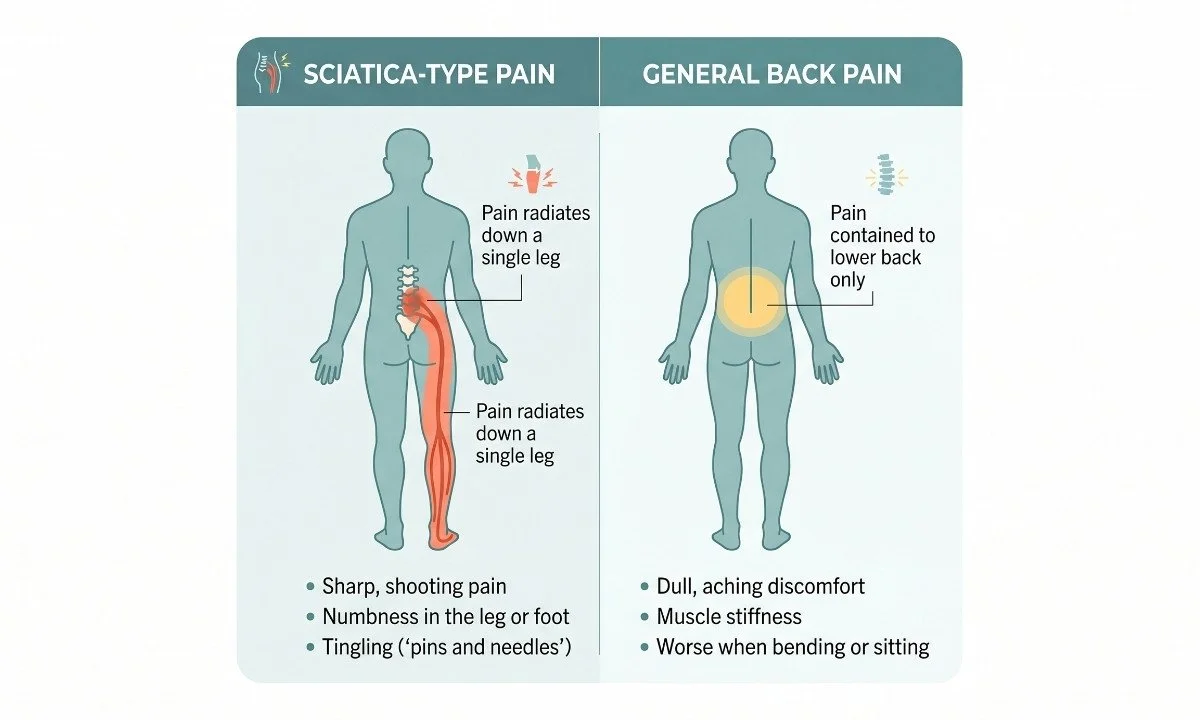
Pain location - Sciatica radiates down one leg; general low back pain stays in the lower back; piriformis syndrome causes buttock pain that may radiate down the leg.
Numbness or tingling - Common with sciatica, rare with general low back pain, and sometimes present with piriformis syndrome.
Worsens with sitting - Often true for sciatica and piriformis syndrome, only sometimes true for general low back pain.
Worsens with stairs or stretching the hip - Often true for piriformis syndrome, only sometimes true for sciatica, and rarely true for general low back pain.
Affects one side or both - Sciatica and piriformis syndrome usually affect one side; general low back pain often affects both sides.
This distinction matters because the right treatment approach depends heavily on the actual source of the pain - not just where it's felt.
When to See a Physiotherapist for Sciatica
Most episodes of sciatica improve with conservative care, but timing matters. Waiting too long to seek treatment can allow compensatory movement patterns to set in, making recovery take longer than it needs to.
Red Flag Symptoms That Need Immediate Care
Seek urgent medical attention if you experience any of the following alongside leg pain:
Loss of bladder or bowel control
Numbness in the groin or inner thighs (saddle anesthesia)
Progressive weakness in both legs
Severe pain following a significant trauma, such as a fall or car accident
These can indicate a rare but serious condition called cauda equina syndrome, which requires emergency evaluation.
Signs Physiotherapy Can Help
For the vast majority of cases, it's appropriate - and often ideal - to book a physiotherapy assessment when:
Leg pain has lasted more than a few days without improvement
Pain is interfering with sleep, work, or daily movement
You notice tingling, numbness, or weakness that isn't improving
You've tried rest and over-the-counter pain relief without lasting results
You want guidance on safe movement instead of guessing what helps
A physiotherapist can identify the specific structures contributing to your symptoms and build a plan around your actual presentation, rather than a generic protocol.
How Physiotherapy Treats Sciatica
Physiotherapy for sciatica typically combines hands-on treatment with active rehabilitation, since research consistently shows that movement-based approaches outperform prolonged rest. A typical plan may include:
Manual therapy to reduce muscle tension and improve joint mobility around the lower spine and hips
Nerve glides (neural mobilization) - gentle movements designed to reduce nerve irritation without aggravating symptoms
The McKenzie method, a system of specific spinal positions and movements used to centralize and reduce referred leg pain
Targeted strengthening exercises for the core, glutes, and hips to support the spine and reduce recurrence
Posture and movement education so daily habits stop feeding the problem
Gradual return-to-activity planning, especially for people returning to work, sport, or exercise
Some patients also benefit from combining physiotherapy with chiropractic care or massage therapy to manage muscle tightness alongside nerve-focused treatment, depending on the individual case.
What to Expect During Your First Physiotherapy Visit
A first appointment typically starts with a detailed history and a physical assessment, including movement testing, reflex checks, and questions about exactly where and when symptoms occur. From there, your physiotherapist will explain what's likely driving your symptoms and outline a treatment plan with realistic timelines. Most plans include both in-clinic treatment and a home exercise program, since consistency between sessions plays a major role in recovery speed.
Sciatica Exercises You Can Try at Home
While a personalized program from a physiotherapist will always be more effective, these gentle movements are commonly recommended as a starting point for mild sciatica:
Knee-to-chest stretch: Lying on your back, gently pull one knee toward your chest, holding for 20–30 seconds
Piriformis stretch: Cross one ankle over the opposite knee and gently lean forward to stretch the buttock muscle
Cat-cow stretch: On hands and knees, slowly alternate between arching and rounding the spine to encourage gentle movement
Walking: Short, frequent walks can help reduce stiffness and support circulation without overloading the nerve
Pelvic tilts: Lying on your back with knees bent, gently flatten and arch the lower back to mobilize the spine
Stop any exercise that increases numbness, sharp pain, or weakness, and check in with a physiotherapist before progressing further.
How Long Does Sciatica Take to Heal?
Recovery timelines vary depending on the underlying cause and how early treatment begins. Many people see meaningful improvement within 4 to 6 weeks of starting physiotherapy, while more involved cases - such as a significant disc herniation - may take several months. Research has shown that up to 45% of people with sciatica continue to experience some symptoms beyond 12 months without appropriate intervention, which underscores why early, targeted treatment tends to produce better outcomes than a "wait and see" approach.
Common Myths About Sciatica
Misinformation about sciatica is everywhere, and some of it can actually delay recovery. Here are a few myths worth clearing up.
Myth: Sciatica always means you need surgery. In reality, the vast majority of sciatica cases resolve with conservative care like physiotherapy, and surgery is typically reserved for cases with progressive neurological loss or symptoms that haven't responded to months of appropriate treatment.
Myth: If it hurts, you should stop moving completely. While avoiding positions that spike sharp pain makes sense, complete inactivity tends to slow recovery by weakening the muscles that support the spine and reducing blood flow to healing tissue.
Myth: Sciatica only affects older adults. While risk does increase with age-related changes like spinal stenosis, sciatica is common in active adults in their 30s and 40s too, often triggered by lifting, twisting, or prolonged sitting.
Myth: A scan will tell you exactly what's wrong. Imaging can be useful in specific situations, but it's well documented that many people without any pain at all have disc bulges visible on MRI. Clinical assessment of how your body actually moves and responds often tells a physiotherapist more than a scan alone.

Frequently Asked Questions About Sciatica
Is sciatica the same as a slipped disc? Not exactly. A slipped (herniated) disc is one possible cause of sciatica, but sciatica itself is the pattern of nerve pain that results - not the underlying structural issue. Other conditions, like piriformis syndrome or spinal stenosis, can produce the same symptom pattern without any disc involvement.
Can sciatica go away on its own? Mild cases often improve with time, movement, and activity modification. However, research suggests a significant percentage of people develop lingering symptoms without proper treatment, so it's worth seeking guidance if pain persists beyond a week or two.
Is walking good or bad for sciatica? For most people, gentle walking is genuinely helpful because it encourages blood flow and discourages stiffness, though pace and posture matter. A physiotherapist can advise on the right amount based on your specific symptoms.
Should I rest in bed if I have sciatica? Extended bed rest is generally discouraged. Brief rest during flare-ups is reasonable, but prolonged inactivity can slow recovery and weaken supporting muscles.
When should I worry that my sciatica is serious? Seek immediate medical attention if you notice loss of bladder or bowel control, numbness in the groin area, or progressive weakness in both legs, as these can signal a medical emergency requiring prompt evaluation.
What Is Sciatica? The Key Takeaways
Sciatica is a symptom, not a standalone diagnosis, and pinpointing its true cause is the key to resolving it. From herniated discs to piriformis syndrome to simple prolonged sitting, the source of your nerve pain determines which treatment path will actually work. While home stretches and activity modification help many mild cases, persistent, worsening, or neurological symptoms are a clear signal that it's time for a professional assessment.
The good news is that sciatica responds well to the right combination of hands-on treatment, targeted exercise, and movement education, especially when addressed early rather than after months of guesswork. Understanding your specific pattern of symptoms - rather than treating every case of leg pain the same way - is what separates lasting relief from a temporary fix.
If sciatic pain has been holding you back from your daily routine, workouts, or sleep, don't wait for it to resolve on its own. The team at Anchor Health and Fitness Centre is ready to assess your symptoms, identify the real cause, and build a physiotherapy treatment plan tailored to your body. Book your assessment today and take the first real step toward lasting relief.
