
C-Section Scar Release: When to Start and Why It Matters
Welcoming a new baby via Cesarean delivery is a profound, life-changing experience, but the physical recovery process involves deep healing that many parents feel unprepared for. While the external skin incision typically closes within a few weeks, the internal tissues undergo a complex remodeling phase that can impact your comfort, posture, and core function for years to come. C-section scar release is a specialized therapeutic approach designed to address these deep tissue restrictions, restore optimal mobility, and help you reclaim full control over your body.
At Anchor Health and Fitness Centre, we encounter many postpartum individuals who experience mysterious lower back pain, pelvic floor dysfunction, or a stubborn "shelf" above their incision, completely unaware that these issues often stem from bound-up scar tissue. Understanding how your body heals and learning when to safely intervene with targeted tissue therapy can dramatically alter your long-term wellness trajectory. This comprehensive guide will break down everything you need to know about tissue restrictions, clinical timelines, and self-care techniques to optimize your postpartum recovery.
What is C-Section Scar Release Therapy?
To truly comprehend the value of C-section scar release, it helps to understand what happens to your anatomy during a surgical delivery. A Cesarean section is a major abdominal surgery where an obstetrician cuts through multiple anatomical layers, including the skin, subcutaneous fat, superficial fascia, deep fascia, and the abdominal wall, before gently parting the muscles and incising the uterus.
As the body heals, it rushes to lay down collagen fibers in a chaotic, haphazard pattern to close these wounds as quickly as possible. This disorganized mesh of dense tissue is what we know as a scar. Unlike normal, healthy muscle and fascial tissue, which is highly elastic and aligned in parallel strands, scar tissue is rigid, less pliable, and prone to binding adjacent layers together.
+——————————————+———————————————————————————+————————————————————————————+
| Tissue Characteristic | Healthy Abdominal Tissue | Scar Tissue After C-Section |
+——————————————+———————————————————————————+————————————————————————————+
| Fiber Alignment | Organized, parallel strands that slide smoothly | Haphazard, cross-linked grid pattern |
+——————————————+———————————————————————————+————————————————————————————+
| Elasticity & Pliability | Highly elastic; stretches and recoils easily | Rigid, restrictive, and resistant to stretching |
+——————————————+———————————————————————————+————————————————————————————+
| Blood & Fluid Flow | Robust circulation and optimal lymphatic drainage| Reduced vascularity; prone to fluid stagnation |
+——————————————+———————————————————————————+————————————————————————————+
| Nerve Sensation | Normal, clear sensory feedback to the brain | Hypersensitive (pain) or hyposensitive (numbness) |
+——————————————+———————————————————————————+————————————————————————————+
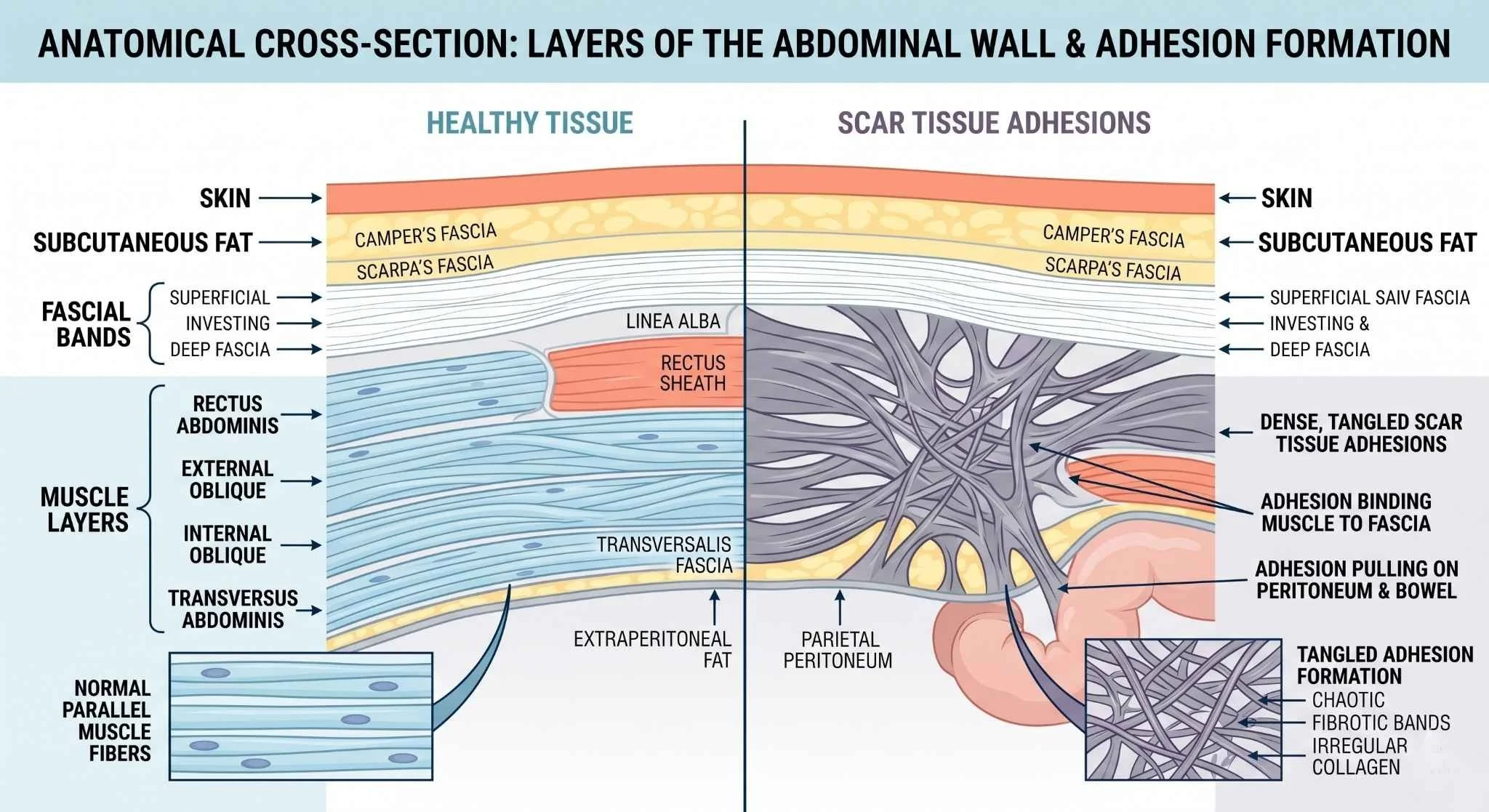
When these layers become stuck together, it creates what clinicians call myofascial adhesions. These adhesions act like internal glue, tethering the skin to the underlying abdominal muscles, the bladder, and even the uterus. This lack of tissue glide can restrict your movement, alter your pelvic alignment, and disrupt the neural communication between your brain and your deep core stabilizers. C-section scar release utilizes manual therapy techniques to systematically break down these cross-linked collagen fibers, encouraging them to realign in a more flexible, functional manner so your tissues can slide smoothly against one another once again.
Why C-Section Scar Release Matters for Your Long-Term Health
Ignoring an abdominal scar can lead to a domino effect of physical compensatory patterns that manifest months or even decades down the road. Because all the fascia in your body is interconnected, a restriction in your lower abdomen can pull on the connective tissue surrounding your hips, pelvis, and lumbar spine. C-section scar release is vital because it addresses the root cause of these systemic compensations, preventing chronic structural issues before they permanently alter your biomechanics.
Many individuals experience a distinct pulling sensation when they try to stand completely upright, which often forces them into a subtle, chronic forward slouch. This altered posture deactivates the gluteal muscles and overworks the hip flexors and lower back muscles, leading to chronic discomfort. By restoring elasticity to the lower abdomen, you eliminate that structural tug-of-war, allowing your pelvis to settle into a neutral position and relieving the constant mechanical strain on your spine.
Furthermore, deep myofascial adhesions can bind directly to the bladder and bowel, limiting their capacity to expand and contract naturally. This structural restriction frequently manifests as urinary frequency, sudden urgency, or unexplained constipation. Mobilizing the deep tissue layers relieves this mechanical pressure, directly supporting healthy visceral function and reducing common pelvic floor issues.
COMMON SYMPTOMS OF DEEP ABDOMINAL ADHESIONS:
• A persistent "tugging" or pulling sensation when reaching overhead or standing straight
• Chronic lower back pain or sacroiliac (SI) joint instability that resists traditional treatment
• Pelvic floor issues, including urinary urgency, frequency, or pain during intercourse
• Hypersensitivity, tingling, or a permanent "velvet-like" numbness around the incision site
• An asymmetrical abdominal "shelf" or pooch that doesn't change with fat loss or general exercise
When to Start C-Section Scar Release: The Optimal Timeline
Timing is absolutely critical when it comes to manipulating surgical wounds. Moving too early can disrupt the delicate initial closure of the tissues, while waiting too long means the collagen matrix will be denser, tougher, and more stubborn to remodel. Understanding the developmental phases of healing ensures you perform the right interventions at precisely the right moments.
Phase 1: Acute Healing (Weeks 0 to 6)
During the initial six weeks postpartum, your primary goal is rest, protection, and gentle circular circulation. The body is focused on cellular repair and sealing the surgical site. Direct scar mobilization must not be performed during this phase. Instead, focus entirely on indirect therapies. Gentle diaphragmatic breathing helps expand the rib cage and gently mobilizes the deep abdominal layers from the inside out without placing external stress on the wound. You can also perform light, superficial skin desensitization by softly stroking a cotton ball or silk scarf over the surrounding skin to normalize altered nerve endings.
Phase 2: Early Sub-Acute Mobility (Weeks 6 to 12)
Once you have cleared your six-week postpartum checkup with your OB-GYN or midwife, and your external incision is completely closed with no open wounds, scabs, or signs of infection, you can begin foundational work. This is the ideal window to introduce C-section scar release techniques because the newly formed scar tissue is highly receptive to remodeling.
Start by working on the tissues around the scar rather than directly on top of it. Gently massage the upper abdomen, the hips, and the area just above the pubic bone to loosen the surrounding fascial matrix. As comfort permits, progress to light, perpendicular pressure over the scar itself to encourage the fresh collagen strands to separate and organize.
Phase 3: Maturation and Deep Remodeling (Months 3 to 12+)
From three months onward, the scar enters its maturation phase, becoming progressively denser. If you have deep-seated adhesions tethered to internal organs, this is the time to apply firmer, more targeted manual therapy techniques.
It is important to note that it is never too late to start scar mobilization. Even if your C-section was five, ten, or twenty years ago, older scars still retain a degree of cellular plasticity. While an older, mature scar may require more consistent, deeper pressure over a longer duration to break apart established adhesions, substantial improvements in tissue glide, core engagement, and pain relief are always achievable.
Step-by-Step Self-Massage Guide for C-Section Recovery

Performing regular self-massage at home is an empowering and highly effective way to support your recovery process. Dedicating just five to ten minutes, three to four times a week, can yield profound changes in the texture, appearance, and mobility of your tissue.
Before you begin, ensure your hands are clean and warm. Sit or lie down in a comfortable, semi-reclined position with your knees slightly bent to slacken your abdominal muscles. You can perform these techniques on dry skin for maximum grip and traction, or use a few drops of high-quality organic oil (such as jojoba, rosehip, or vitamin E oil) if your skin feels dry or sensitive.
Technique 1: Skin Rolling
Place your thumbs and index fingers on either side of your scar, gently pinching a small fold of skin and fat. Slowly roll this tissue fold between your fingers, moving horizontally from one end of the scar to the other. If you hit an area where the tissue feels tightly glued down and cannot be pinched, hold gentle pressure there for 30 seconds until you feel a subtle softening before moving on.
Technique 2: Perpendicular and Parallel Friction
Place the pads of two or three fingers directly onto your scar line. Apply enough downward pressure to anchor onto the tissue without sliding over the skin. Move your fingers firmly in a slow, circular motion, working your way along the entire length of the incision. Next, shift to back-and-forth movements: first parallel to the scar, then perpendicular (up and down) across the scar. This multi-directional friction prevents fibers from fusing together in a single rigid direction.
Technique 3: The "S" Wave Manipulation
Using both hands, pinch the scar tissue between your thumbs and pointer fingers at two adjacent spots, roughly an inch apart. Gently push one hand upward while pulling the other hand downward, creating an "S" shape in the tissue. Hold this directional stretch for 15 to 30 seconds, breathing deeply into your abdomen. Repeat this process across the entire length of your scar to disrupt stubborn, multi-layered adhesions.
The Crucial Link Between Scar Healing and Core Function
Many postpartum individuals struggle to retrain their deep core muscles after a surgical birth. They may perform endless core stability exercises, yet continue to experience a protruding lower abdomen or persistent pelvic floor weakness. This frustration often traces back to the neurological and mechanical disruptions caused by unresolved abdominal adhesions.
When tissues are bound together, the mechanoreceptors and proprioceptors within the abdominal wall send altered, distorted signals to the central nervous system. The brain, sensing restriction and potential trauma at the surgical site, naturally down-regulates or "mutes" the neural drive to the deep transversus abdominis and pelvic floor muscles. Essentially, your body forgets how to efficiently turn these muscles on because the tissue structural framework is locked.
THE CORE RECOVERY ARCHITECTURE:
1. Scar Tissue Release -> Breaks down dense, binding collagen adhesions
2. Proprioceptive Restoration -> Normalizes neural signals from abdomen to brain
3. Motor Unit Recruitment -> Re-awakens the deep transversus abdominis muscle
4. Progressive Load Loading -> Integrates core function into functional, daily movements
By utilizing C-section scar release to free these fascial layers, you open up the physical space required for these muscles to contract, lengthen, and slide naturally. This structural freedom immediately restores clear neural pathways, making it vastly easier to connect with and strengthen your deep core during functional fitness training. True core stability cannot be built on top of a restricted, anchored foundation; liberating the tissues must always precede heavy strength training.
When to Seek Professional Clinical Care
While self-massage is an incredible tool for daily maintenance, there are times when partnering with a clinical professional is essential to achieving a full recovery. Specialized practitioners possess advanced anatomical knowledge and refined manual skills that allow them to safely access deeper fascial planes that are difficult to target on your own.
If you attempt self-massage and experience sharp, radiating pain, severe nausea, or intense emotional distress, it is time to step back and seek professional guidance. It is entirely common for emotional trauma from a difficult or emergency birth to store itself physically within the pelvic and abdominal tissues; a trained therapist can provide a safe, trauma-informed environment to navigate this physical and emotional release.
Furthermore, if your scar feels exceptionally thick, resembles a raised, hard cord (hypertrophic or keloid scarring), or if you are dealing with chronic pelvic floor issues like incontinence or pelvic organ prolapse, professional intervention is highly recommended. Clinicians can utilize advanced modalities such as pelvic floor physiotherapy, targeted myofascial release, dry needling, or specialized instrument-assisted soft tissue mobilization (IASTM) to accelerate your healing safely.
At Anchor Health and Fitness Centre, our integrated team specializes in comprehensive postpartum rehabilitation. We look beyond the surface incision, assessing your entire global movement system-including hip mobility, pelvic alignment, breathing mechanics, and core firing patterns-to curate a highly personalized recovery strategy that addresses your specific structural needs.

Frequently Asked Questions About Postpartum Tissues
Can I perform scar release if my C-section was years ago?
Yes, absolutely. While fresh scar tissue is more pliable and easily altered, older scars retain a continuous baseline of cellular turnover and can still be effectively remodeled. If your surgery occurred years or even decades ago, you can still experience profound improvements in tissue mobility, posture, and localized sensation by consistently applying deeper, targeted manual techniques over a sustained period.
Why does my scar feel completely numb or weirdly tingly?
During a Cesarean section, the superficial sensory nerves running through the lower abdominal wall are inevitably transected or stretched. As these delicate nerve endings attempt to regenerate, they can produce sensations of complete numbness, hypersensitivity, burning, or tingling. Regular, gentle massage and varied sensory stimulation help desensitize hyperactive nerves and encourage healthy neural pathways to re-establish.
What is the distinct "C-section shelf" and will massage fix it?
The common "C-section shelf" refers to a pouch of skin or fat that visibly overhangs the surgical incision line. This occurs because the scar tissue beneath the skin is tightly adhered to the deep abdominal wall, acting like a tight, unyielding rubber band that pulls inward while the unadherent surrounding tissues naturally rest over it. Releasing the deep fascial adhesions softens this tight anchor, allowing the abdominal contour to smooth out naturally.
Is it normal to feel emotional during an abdominal massage?
Yes, it is incredibly common and entirely normal to experience a sudden surge of emotion-such as sadness, anger, anxiety, or even a sense of profound relief-while massaging your abdomen. The pelvic and lower abdominal regions frequently store physical and emotional tension related to the birth process, particularly if the delivery was unexpected or traumatic. If this occurs, breathe deeply, go gently, and consider working alongside a trauma-informed clinical specialist.
Reclaiming Your Strength and Vitality
Your body performed an extraordinary feat in growing and delivering your baby, and the physical mark left behind is a testament to that powerful journey. However, a healed incision should never come at the cost of your daily physical comfort, functional mobility, or athletic vitality. Investing time and care into C-section scar release is a vital act of restorative self-care that directly protects your pelvic health, structural alignment, and long-term well-being.
Whether you are a few months postpartum or navigating life years after your delivery, your tissues possess an incredible capacity to adapt, soften, and heal when given the right stimulus. Listen to your body, remain patient with the process, and never hesitate to lean on professional expertise to guide you through your recovery.
If you are ready to resolve persistent abdominal pulling, heal chronic lower back discomfort, and effectively rebuild your core stability from a deep, structural level, we are here to support you every step of the way. Connect with our dedicated, specialist team at Anchor Health and Fitness Centre today to book a personalized postpartum assessment. Let us help you break free from restrictions so you can move, train, and live with absolute confidence and ease.